

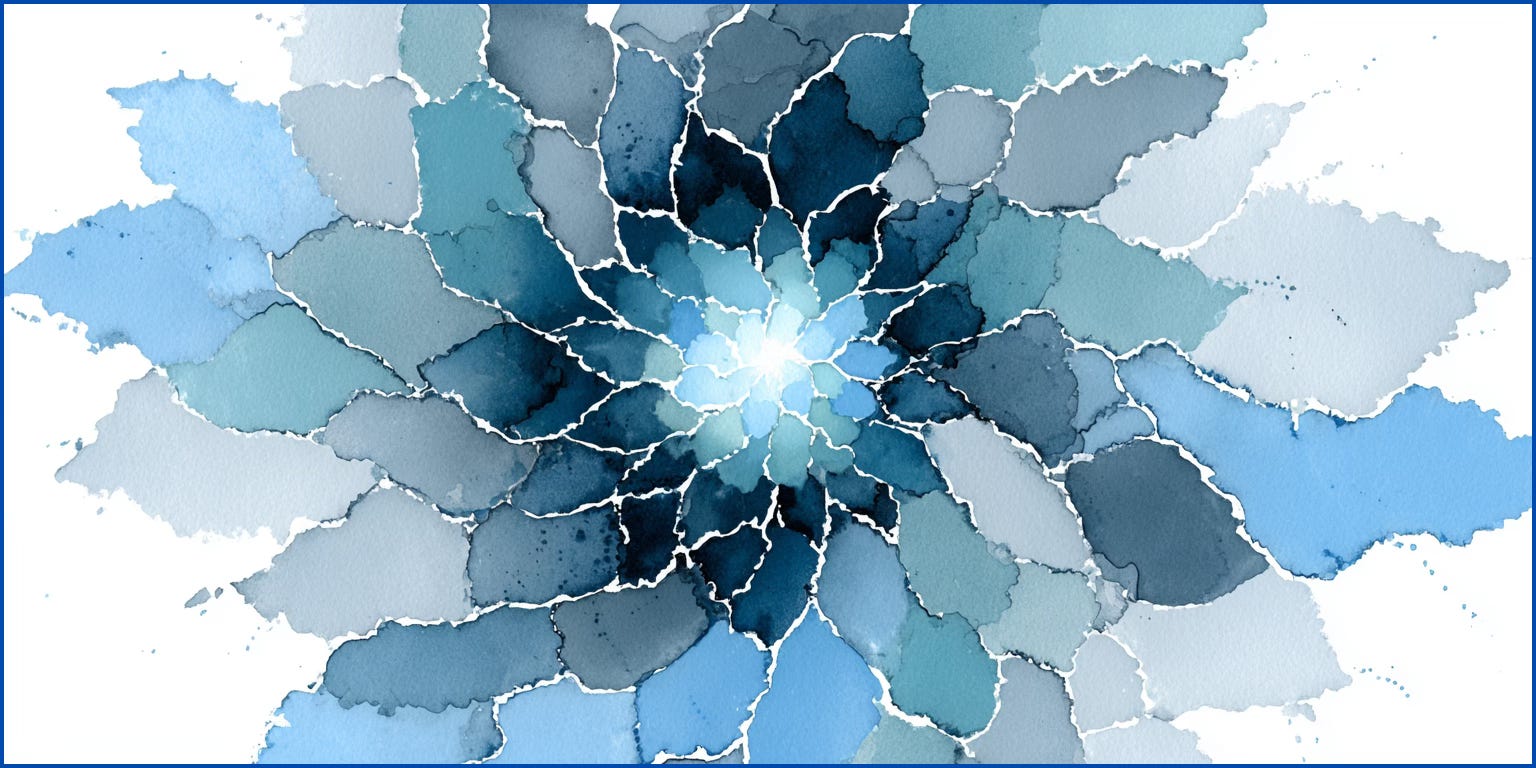
Nature, within the Paraclete Taoist framework, is understood as an intelligent and relational field of ongoing participation rather than inert matter or a collection of separate resources.
Nature is the living context from which all beings emerge and within which all beings remain embedded. Human life is not positioned outside this reality, observing it from a distance, nor does it stand above it as master. We arise within the same processes that shape forests, coastlines, weather systems and the countless forms of life that share the world with us.
The modern tendency to divide humanity from nature has profound consequences. Once the living world is reduced to object, resource or property, relationship gives way to extraction. Yet, the natural world reveals something quite different. Every landscape carries the accumulated effects of time and adaptation; or of disturbance and then recovery, and later, renewal. A river valley records its history in the contours of its banks. A forest bears witness to drought or abundance. The land itself becomes a form of memory through which life continuously learns and reorganises.
To enter such a world requires a different posture. Knowledge is no longer acquired solely through analysis or control. It emerges through attentiveness. One learns to notice the subtle ways in which place shapes perception, behaviour and understanding. The movement of seasons teaches timing. The turning of ecological cycles reveals the necessity of restraint. Long observation cultivates humility before complexities that exceed immediate comprehension. In this sense, the land is not merely occupied. It becomes teacher.
This understanding extends to the human organism. The body is not a machine operating independently of its surroundings. It is a living expression of relationship, such that light influences hormonal rhythms and movement alters metabolism. Environmental signals continually inform immune activity or mood. Human physiology evolved upon dynamic engagement with the living world and continues to depend upon that engagement. When these relationships become impoverished or distorted, consequences emerge that cannot always be understood by examining isolated biological parts alone.
Many of the difficulties characteristic of modern life can be viewed through this lens. The exhaustion, fragmentation, and chronic dysregulation increasingly observed throughout contemporary society reflect more than individual pathology. They point toward a broader loss of participation in the rhythms and relationships that once helped organise human experience. The issue is not simply that people spend less time outdoors. It is that the structures of modern civilisation often encourage forms of living that separate human beings from the ecological realities upon which health ultimately depends.
From this perspective, spirituality is not concerned with escape from the world. It begins with deeper participation in it. The sacred is encountered not beyond nature, but through it. A person learns reverence through attention, gratitude through dependence, and humility through recognising their place within a reality far larger than themselves. Care for land is needed, as is stewardship of resources. Fidelity to truth and responsibility toward future generations become spiritual practices because they express alignment with the conditions that sustain life.
This orientation also challenges the modern tendency to treat knowledge as primarily abstract. Some forms of understanding cannot be separated from lived experience. A landscape known through decades of relationship reveals dimensions that remain invisible to brief observation. Wisdom develops through participation. It is carried in memory, story and in practice. It is the accumulated insights of those who have learned to listen carefully to place and it is inherited via generations. Such knowledge is not opposed to science. Rather, it complements scientific understanding by recognising that relationship itself is a source of insight.
Underlying this worldview is the recognition that life displays a remarkable continuity of organisation. The forces that sustain vitality are not arbitrary. Living systems remain healthy when exchange is balanced, when limits are respected, and when renewal is permitted to occur. Whether considering a watershed recovering after disturbance, a community rebuilding trust, or an individual recovering from illness, the same fundamental reality becomes visible: flourishing depends upon the maintenance of relationships that support coherence.
Coherence, therefore, occupies a central place within the Paraclete framework. It is not simply a psychological state or a measure of physiological efficiency. It describes the capacity of living systems to remain integrated while adapting to change. Wherever coherence is present, life expresses resilience, creativity, and vitality. Wherever it is lost, fragmentation gradually emerges. The task of both health and spirituality becomes the restoration of conditions that allow coherent participation to reappear.
Nature is therefore more than environment. It is revelation. Through its patterns, cycles, limits and possibilities, it discloses the principles by which life sustains itself. The invitation is neither conquest nor withdrawal, but relationship. By learning once again how to participate within the living order rather than standing apart from it, human beings recover not only ecological responsibility, but a deeper sense of belonging, meaning, and wholeness.
As a foundational expression of the Paraclete worldview, this perspective invites a renewed relationship with the living world and our place within it. Through attentive participation, responsible stewardship, and fidelity to the realities that sustain life, human beings rediscover belonging. From belonging emerges meaning. From meaning emerges wholeness.
